

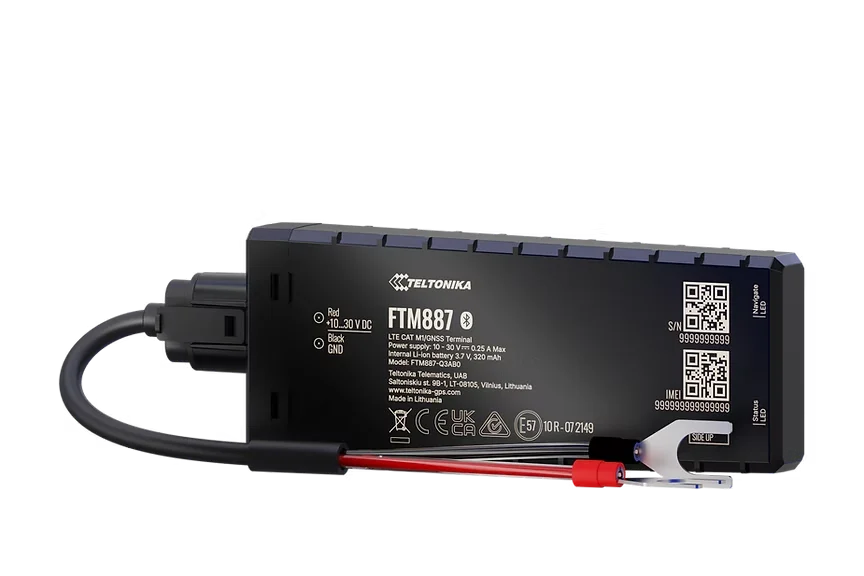
Teltonika Trackers Explained: A Fleet Operator's Guide
Timi
If you have researched GPS tracking for a fleet, you have run into Teltonika, even if the tracker on your dashboard carried someone else’s badge.
Teltonika is one of the biggest names in tracking hardware, and its devices sit underneath a huge share of the tracking services sold across Europe. This guide covers who they are, what each range is for, and the part most people miss: the hardware is only half the job.
Who Teltonika actually is
Teltonika is a Lithuanian manufacturer that has been building tracking hardware for more than 25 years. By its own figures it has shipped tens of millions of devices and operates across dozens of countries. It is a serious, well-supported engineering business, not a cheap import brand.
The important thing to understand is the model. Teltonika sells hardware and the tools to manage it at scale. It sells mostly to integrators and service providers, not to end users. The tracker is theirs. The dashboard you actually log into, the SIM, the install and the support usually come from someone else.
The tracker ranges, and what each is for
Teltonika does not make one tracker. It makes families of them, each aimed at a different job. Here is how the main ranges break down.
| Range | What it does | Best for |
|---|---|---|
| Fast & Easy | Mounts in minutes with no tools or wiring | Large rollouts where install time is the cost |
| Basic | Core location and trip tracking at a low price | Everyday visibility, big deployments |
| Advanced | Adds driver ID and behaviour, flexible inputs | Fleets that need accountability |
| OBD data | Plugs into the OBD port, reads mileage, RPM, fuel and fault codes | Quick fits, diagnostics, rotated stock |
| CAN data | Reads deeper vehicle data and can control doors or windows remotely | Rich data and remote control on supported vehicles |
| Professional | Tachograph download, CAN, and external equipment | HGV and heavy transport, compliance-heavy work |
| Assets & workforce | Self-powered, battery-based trackers | Trailers, unpowered assets, lone workers, backup |
Their long-time bestseller, the FMB920, has sold in the millions on its own, which tells you how much of the market runs on this hardware.
A quick word on CAN bus, since it comes up a lot. CAN data means reading the vehicle’s own network directly, so you get accurate fuel, mileage and engine information rather than estimates. The catch is that support depends on the exact make, model and year, so the “supported vehicle list” matters far more than the headline feature.
The features that matter for UK fleets
Across the ranges, the capabilities that earn their keep for an operator are the security and accountability ones.
- Stolen vehicle recovery. Real-time location and movement alerts so a stolen vehicle can be tracked and recovered.
- Secure vehicle disabling. Support for an immobiliser so a vehicle can be stopped from being driven off, which pairs naturally with a proper immobiliser setup.
- Driver authentication. RFID or iButton readers so only authorised drivers can use a vehicle, and every trip is tied to a person.
- Driver behaviour. Harsh braking, speeding and idling data to cut fuel and insurance costs.
- Dead Reckoning. The tracker keeps estimating position even when the GPS signal is jammed or lost, which matters given how often thieves now use signal jammers.
- Video and sensors. Optional camera and Bluetooth sensor support for accident footage, temperature monitoring and trailer tracking.
If you want the wider picture on how these pieces fit a UK fleet, our practical GPS tracking guide for UK operators walks through it.
Where Teltonika stops, and what you still need
Here is the part the spec sheets do not spell out. A Teltonika tracker in a box is not a tracking system. To turn it into something your team can actually use, four things have to be added on top.
First, a platform. Raw hardware sends data, but you need a dashboard that shows live location, trips, alerts and reports in a way a busy operator can read at a glance. Second, connectivity. Every device needs a SIM and a data plan, provisioned and managed, or it goes silent. Third, installation and configuration. These devices are deeply configurable, which is a strength in expert hands and a liability in the wrong ones, and a poorly fitted tracker is a poorly performing one. Fourth, support. When a device drops off or a driver disputes a trip, you need someone to call.
Buy hardware alone and all four land on you.
Choosing hardware, or choosing a partner
This is the real decision. You are not just picking a tracker, you are picking who owns the outcome.
Sourcing devices yourself can look cheaper on the invoice. It stops looking cheaper the first time you are configuring firmware, chasing a SIM provider and building reports at the same time. The alternative is a managed service that selects the right hardware for each vehicle, fits and configures it, runs the connectivity, and gives you one dashboard and one number to call.
That is what we do at Traknova. We deliver GPS tracking and fleet management as a complete service, proven hardware wrapped in a platform, connectivity and UK support, so you get the visibility without becoming a telematics engineer. For logistics, taxi and PHV, rental and dealership fleets, that difference is the whole point. And if your vehicles already have connectivity built in, digital fleet tracking can give you visibility with no hardware to fit at all.
Summary
Teltonika builds excellent, proven tracking hardware, with a range for almost every vehicle and use case, from quick-fit devices to full CAN and tachograph reading. But a tracker is not a solution. The platform, connectivity, install and support around it are what turn good hardware into a fleet you can actually run. Choose the outcome, not just the box.
Frequently asked questions
Can I buy Teltonika trackers directly?
Teltonika sells primarily to integrators and managed service providers, not to end users. You can source devices through a distributor, but you will still need to arrange the platform, SIM, configuration and support separately. Most operators find it cheaper in practice to go through a managed service that handles all of that.
Which Teltonika device should I use for my fleet?
It depends on the vehicles and what you need. OBD devices suit fast-rotating stock. The Basic and Advanced ranges cover most everyday fleet use cases. CAN and Professional devices are for heavy vehicles or setups where rich vehicle data and remote control matter. The right choice also depends on your platform and what data it can actually use.
What is the difference between OBD and CAN data?
OBD reads from the standard diagnostic port and gives you a useful but limited data set. CAN bus connects directly to the vehicle’s internal network and gives you more accurate fuel consumption, mileage and engine data. The catch is that CAN support varies by vehicle make, model and year, so you need to confirm your specific vehicles are on the supported list before relying on it.
Do Teltonika trackers work in the UK?
Yes. Teltonika devices are widely used across Europe and the UK, and support UK mobile networks. You will need a UK-compatible SIM and a platform configured for UK use, but the hardware itself is not a barrier.
What platform do I need alongside Teltonika hardware?
Teltonika provides Teltonika Telematics and other backend tools, but most operators access their fleet through a third-party platform that sits on top. Your service provider should supply this. Without a platform, you have hardware that sends data nowhere.
Want to see what that looks like for your fleet? We can spec it with you.