
Know what every leased vehicle is doing. Long before it comes back.
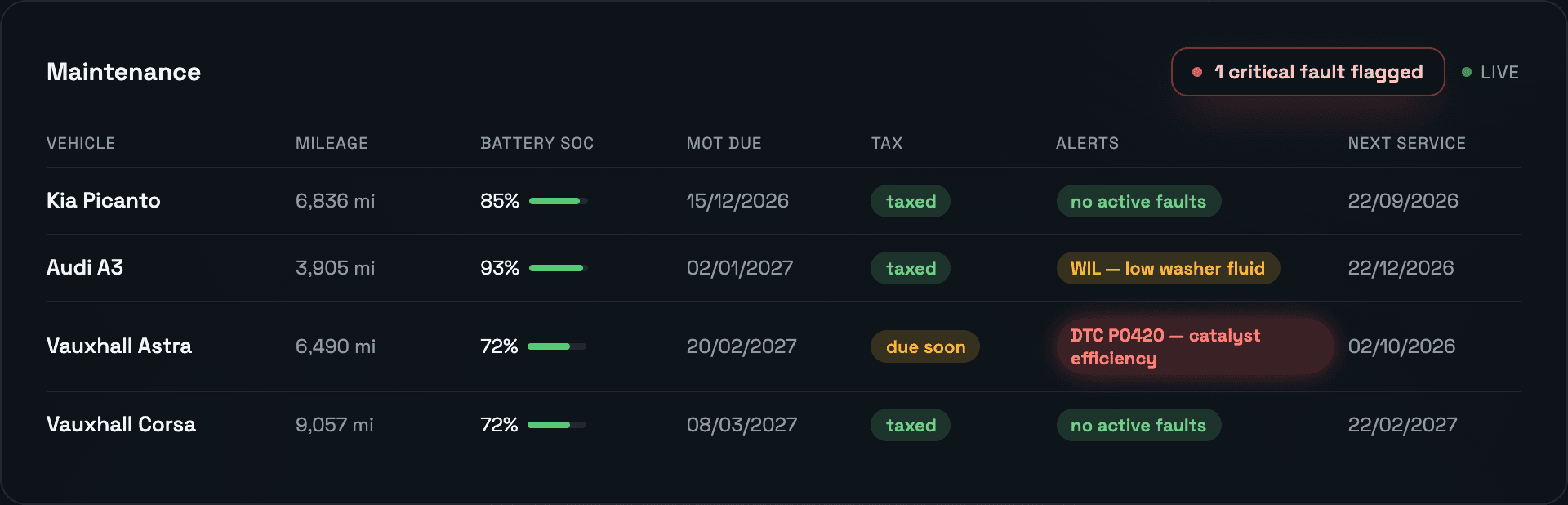
Traknova gives leasing companies live mileage, service status and fault alerts across the whole book, taken straight from the vehicle. Reprofile contracts before mileage becomes a dispute, protect residual values, and forecast defleet with real numbers instead of estimates.
You find out what the vehicle did on the day you get it back.
A contract is written on an assumed annual mileage and a forecast residual value. Then the vehicle disappears for three or four years. You see it again at defleet, and by then every variance has already happened. The mileage is what it is. The missed services have already cost you at auction. The excess mileage invoice goes out, gets disputed, and some of it never gets collected.
None of that is a billing problem. Billing accurately is easy. The problem is that you are billing for something the customer did not know was happening, years after you could have done anything about it.
Contract written on: an estimate.
Vehicle monitored for: nothing, for four years.
Traknova: real mileage and service status, from month one.
Live Vehicle Data
Four fields that change how you manage the book.
Live mileage against contract allowance
Real odometer readings, not driver-reported estimates. See which contracts are tracking over allowance and by how much, at any point in the term rather than at the end of it.
Next service due
The manufacturer's own service date and distance for every vehicle. Know which vehicles are overdue before the miss becomes a residual value problem.
Fault and warning alerts
Warning lights and fault codes as they trigger. On a maintenance-inclusive contract that means catching a small job before it becomes a large one.
Location, where it is needed
Available for default, early termination and recovery situations, subject to the consent position agreed in the contract. Not switched on across the book by default.
Data availability varies by manufacturer, model year and whether the vehicle's connected services are active. We run coverage on a sample of your actual VINs and give you the real figure before you commit.
Mid-Term Reprofiling
Turn a disputed invoice into agreed monthly revenue.
A customer running 40% over their allowance at month eight is not a problem you have to wait for. It is a contract amendment conversation you can have now, while there is still term left to spread it across.
Reprofiling early means the revenue comes to you monthly instead of as a single contested charge at defleet. The customer avoids a bill they did not budget for. Your collection rate goes up because nobody is being surprised. And the renewal conversation happens with a customer who feels well managed rather than caught out.
Threshold alerts
Flag any contract crossing a set percentage over its expected mileage profile, at whatever point in the term you choose.
Whole-book view
See every contract tracking over or under allowance in one place, so reprofiling becomes a monthly process rather than an exception.
Evidence the customer accepts
Figures come from the vehicle's own odometer, so the conversation starts from an agreed number rather than an argument about one.
Protect the value you underwrote.
Your residual value forecast assumes a vehicle that has been serviced on schedule and returned in fair condition. A missed service and an incomplete history reduce what the vehicle makes at auction, and that loss sits with you, not the customer.
Service due alerts let you prompt the customer before the miss happens. On maintenance-inclusive contracts they let you get the vehicle booked in rather than waiting for the driver to notice. Either way, the vehicle that comes back is the vehicle you priced.
Forecast what is coming back, and roughly what it is worth.
Real mileage across the book tells your remarketing team what is due to defleet, at what mileage, and in what condition band, months before the collection is booked. That turns disposal planning from a reactive process into a forecast, and it gives you a longer window to choose between auction, retail and customer purchase on each unit.
This does not put you between the driver and their car.
Your customer owns the driving relationship, and no leasing company wants to be the one explaining to a fleet of drivers that their journeys are being watched. Traknova is built around contract data, not surveillance.
Mileage, service status and fault alerts tell you whether the contract is on track and whether the asset is being looked after. That is what your agreement already entitles you to know. Location is available only where the consent position supports it and the situation requires it, such as default or recovery, and it can be disabled entirely at policy level.
Where it helps, the same data can be shared back to your customer, so they can see their own mileage position rather than finding out at defleet.
Live in days. Nothing fitted to any vehicle.
01
Send us a sample of your book
VINs or registration numbers, with contracted annual mileage where you have it.
02
We run coverage and benchmark it
You get a report showing which vehicles report data, what fields come back, and how actual mileage on that sample compares to the allowance each contract was written on.
03
Roll out across the book
Contracts appear in the dashboard with live mileage, service status and alerts. No hardware, no driver involvement, no vehicle downtime.
Vehicle leasing questions
Send us 100 live contracts. We will tell you where you stand.
No cost, no commitment. Pick 100 contracts off your book and we will return real mileage against contracted allowance for each one, plus service status and how much of the sample we can see. Most lessors are surprised by the spread.
Book Your Free Demo →